

Most people who buy or sell a business never get what they came for. Not because they got the wrong number. Because they focused on the wrong things.
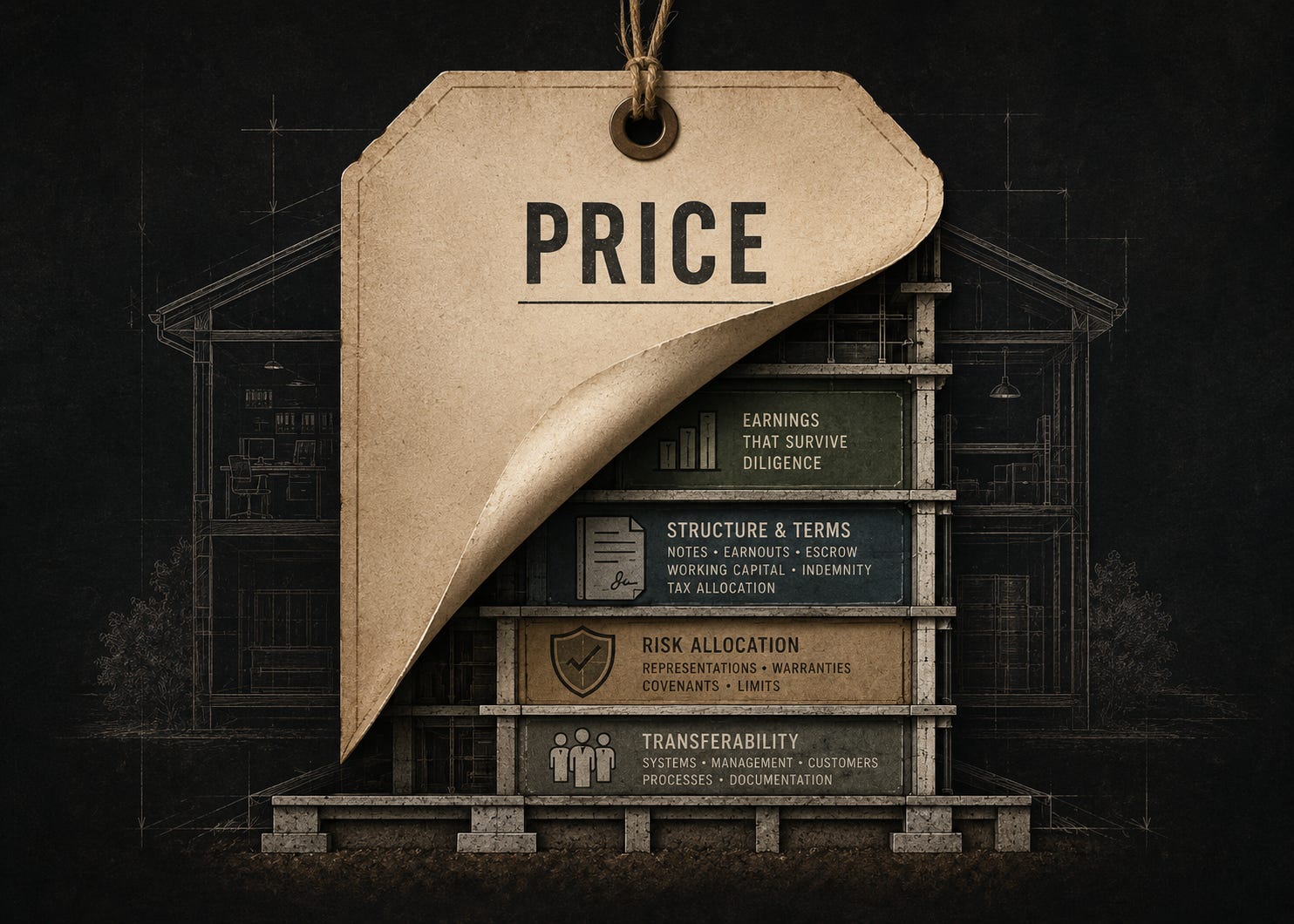
The success of a deal rarely depends on price. It depends on the earnings base, the structure, the risk allocation, and whether the business is actually transferable after the owner leaves. Plus the personal paradigm the deal is engineered to challenge.
On Owning covers all of it. Both sides of the table. Plain language. Weekly.
TL;DR
Valuation usually starts with what earnings survive diligence. The multiple matters, but not as much. The earnings underneath it is where most of the money is decided.
The purchase price is just the headline. The real outcome is buried in the details such as notes, earnouts, escrow and holdbacks, tax allocation, working capital peg, and indemnity terms.
Multiples don’t rise because sellers think the business is special. They rise when buyers think the risk is low. Sellers can move that, with planning.
A good business is not the same as a good deal. A good offer is not the highest offer. Both sides are picking the right deal for them specifically.
Whether an acquisition delivers life-changing freedom or lifetime regret has little to do with the deal itself, and everything to do with the beliefs, values, lived experience, and daily life the deal is engineered to challenge.
Where valuation actually starts
Most people think valuation starts with the multiple. It usually starts with what earnings survive diligence.
Owners and buyers spend a lot of time on what number to multiply earnings by. Three times. Three and a half times. Five times. That conversation matters. But there’s a more important one happening underneath it. What earnings amount gets multiplied at all.
A 4x multiple on shaky earnings is worse than a 3x multiple on clean earnings. The smaller multiple wins because the earnings number underneath it is something a buyer can actually rely on.
Most owners assume the add-backs they list survive the process. On average, over 20% of EBITDA shows up as claimed add-backs across LOIs. I’ve seen cases where add-backs make up over 50% of “earnings”. Clean documentation and not abusing the tax code is what moves a buyer from repricing every add-back to accepting most of them.
Owner compensation is one of the biggest swings. If the owner is paying themselves $80K to run a business that needs a $200K manager once they’re gone, that’s driving the earnings number down. The opposite is true as well. Our goal is to reach a normalization of what it takes to run the business.
The shift between SDE (what an owner-operator earns) and EBITDA (what an institutional buyer would underwrite once they hire a manager) often catches owners off guard. Same business. Same revenue. Different earnings number depending on who’s pricing it.
Don’t ask what the multiple is until you know what earnings base survives diligence. That’s where most of the money is decided.
What’s hidden in the structure
The purchase price is just the headline. The real deal is what’s buried in the details such as notes, earnouts, escrow and holdbacks, tax allocation, working capital pegs, and indemnity terms.
A $5M deal in all cash is not the same as a $5M deal with a 30% earnout, a 15% seller note, an escrow holdback, and a working capital adjustment. Same headline number. Three or four different outcomes that will show up about 12 months later.
Earnouts are usually pitched as bridge-the-gap dollars, money the seller will probably get. The data tells a different story. Across private-company deals, only 59% of earnouts pay anything at all and only 21 cents of every promised dollar reaches the seller. There’s a lot the seller can do to change that payout rate with the right structure and the right advice.
Working capital adjustments are the next quiet mover. They show up in more than 90% of acquisitions. The peg gets set during negotiation. The closing balance sheet gets measured against it. A small mismatch between how the peg was built and how the close gets calculated can move serious dollars after the LOI is already signed.
Tax allocation is another one most people miss. In an asset deal, the buyer and seller have to decide how the purchase price gets allocated across goodwill, equipment, non-compete, inventory, and other classes. The allocation moves the after-tax proceeds for the seller and the depreciation schedule for the buyer. A higher headline price with a worse allocation can leave the seller with less than a lower headline price with a cleaner one.
Price is one negotiation. The structure is where the real outcome gets decided.
What actually moves the multiple
The multiple isn’t just some industry average. That might be a place to start, but in all but the most “average” deals the swings could be significant.
The multiple is a risk number. Higher multiple, lower perceived risk. Lower multiple, higher perceived risk. Industry averages hide this because every company in an industry carries different risk profiles.
A boring business with sticky customers and a real second layer of management will almost always sell for a higher multiple than an exciting business with a few key relationships and one indispensable owner.
Several levers move the multiple down: owner dependence, customer concentration, weak management depth, heavy capex needs, thin or volatile margins. Several move it up: recurring revenue, strong cash conversion, a real second layer of management, sticky customer relationships, documented processes, low concentration. Each one can be improved. Most of them respond to 12 to 18 months of focused work if the owner starts before the deal is on the table.
Owner dependence is the biggest one. If the business runs on the owner’s relationships, the owner’s instincts, and the owner’s daily presence, the buyer is buying a job with employees attached. A buyer who has to replace the owner before they can collect the cash flow is going to pay less or pass altogether. Building a second layer of management, documenting decisions, and stepping back operationally before the sale moves the multiple in a way that nothing else does.
Customer concentration is the second biggest. One customer at 25% of revenue looks like a strong relationship to the seller and a real risk to the buyer. The same earnings number with diversified customers is worth more than the same number with concentrated ones.
I’ve seen businesses with similar EBITDA and in similar industries vary between a 2x and 6x multiple because of this.
But the multiple is more in the owner’s control than most realize. It just takes time and intent.
What makes a deal good
A good business is not the same thing as a good deal. A good deal is a business the buyer can finance, operate, transfer, and improve without depending on the seller forever. And one where both parties can realize their desired life post-acquisition.
For buyers, this is the part that gets confused most often. A strong company can still be a bad deal. The price might be wrong. The debt service might consume every dollar of free cash flow. The owner might be the operation, which means the cash flow disappears the day the owner walks out the door.
Or the business might be a perfectly good business and the wrong fit for this specific buyer’s life. Capital gets you to the table. Fit, energy, industry knowledge, and the life the buyer wants on the other side decide whether they should sit down.
A good offer is not necessarily the highest offer. It is the best mix of cash, certainty, tax outcome, buyer fit, and post-close risk.
For sellers, this is harder than it sounds.
The highest offer amount is easy to anchor on. It’s also the easiest to get wrong.
A high offer from a buyer with shaky financing has a real chance of falling out of contract or retrading hard during diligence. A high offer paired with a punishing tax allocation can deliver less to the seller than a smaller offer with a tax structure more favorable to the seller. A high offer from a buyer with no transition plan can put the employees, the customers, and the seller’s earnout at risk all at once.
For sellers, it’s net proceeds that matters. But that’s rarely what people talk about.
Both sides of the table need to figure out what the right deal is for them. And when that happens on the same deal, it closes fast and nobody looks back with regret.
What the deal asks of you
Whether an acquisition delivers life-changing freedom or lifetime regret has little to do with the deal itself, and everything to do with the beliefs, values, lived experience, and daily life the deal is engineered to challenge.
The deal closes on the same day for both sides. So does a chapter in each of their lives.
The seller wakes up Monday, gets dressed for work, and realizes that part of their life is over. They have no place to go. The relationships they spent years building have changed overnight.
For the buyer, running the business gets harder and harder - mentally, emotionally, physically, financially. They start questioning whether leaving their W2 was the right call.
Both start asking themselves tough questions. Regret starts to sink in. The shame is that those questions could have been addressed early on. But they don’t know to ask, and nobody else is raising them.
I call this “The Closing Paradigm”.
This is the part the M&A industry skips. On Owning doesn’t.
Why this is here
Over the past five years, I’ve been fortunate to bring my insights to tens of thousands of buyers and owners through workshops, courses, conferences, and lots and lots of Zoom calls.
I’ve had hundreds of in-depth conversations with everyone involved in acquisitions - buyers, sellers, advisors, attorneys, lenders, family members - you name it. People working through what they were facing, thinking out loud about deals that hadn’t happened yet, deals that were stuck, deals that closed, and the parts of life that came after.
I started advising in acquisitions over two decades ago as a CFA charterholder working with highly successful owners. Since then I’ve participated in my own deals as both a buyer and seller. I’ve worked on over two hundred deals in one capacity or another. And I’ve been able to advise and coach thousands which has really let me get inside the minds of deal makers.
I’ve been able to get an inside look at what makes a great deal. And I’ve been able to see the life-changing impact a great deal can have.
On Owning is where I’ll share that knowledge and the insights I’ve learned along the way. For both buyers and owners - those making a move today and those planning a move down the road. Plain language, weekly.
One question to start
If you’re buying or selling a business, or thinking about either someday, I want to hear from you. What’s your single biggest M&A challenge right now?
Reply to any post and tell me. I read every one. The answers shape what I write next.
If you’re not in the deal world yet but you can feel it pulling at you, that counts too. Tell me what you’re trying to figure out.
Over the coming weeks, I’ll go deeper on all of this and more.
The work starts now. So does this publication.